
Play Wild Swarm Now!
Home → Strategy
Wild Swarm Strategy
Approaching Wild Swarm sensibly
Push Gaming released Wild Swarm in 2020, establishing a foundation for players who understand that the theoretical return to player stands at 97.03%. This figure represents the house edge of 2.97% over an extended period, meaning the casino retains a small percentage of all wagers placed on this specific title. Beginners should recognize that this edge applies regardless of short-term outcomes or lucky streaks during initial play sessions.
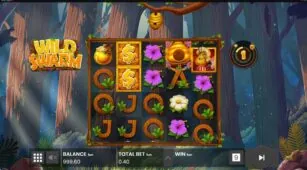
The game features a 5x4 reel layout with 20 win lines, providing a structured environment for new users to learn mechanics without excessive complexity. Unlike high-volatility crash games, this slot offers Bee Feature wilds and a honeycomb multiplier trail that trigger more frequently than rare jackpots. Understanding these standard features helps beginners manage expectations regarding how often winning combinations appear on the digital reels.
Maximum wins reach 3,100x the stake, which is significantly lower than titles like Bamboo Big offering 50,000x potential payouts. This constraint ensures that bankroll depletion happens gradually rather than through sudden, catastrophic losses common in higher-variance products. New players benefit from this stability as it allows for longer engagement while learning the specific rules of the Push Gaming interface.
Bankroll rules that hold up
A defined bankroll must cover at least one hundred spins at the minimum bet to withstand normal variance in Wild Swarm's medium-high volatility. With a base stake potentially starting near 0.20 euros per spin, setting aside twenty euros provides a buffer against the inevitable dry spells between feature triggers. This mathematical buffer prevents emotional decision-making when the balance dips below initial deposits during early gameplay rounds.
The welcome bonus of 300% up to 2,000 euros plus 100 free spins can extend playtime if wagering requirements are met through steady flat betting. However, using progressive staking strategies raises stakes after losses, which does not change the built-in edge and only accelerates the time to ruin. Beginners should avoid increasing bets to recover losses, as the 97.03% RTP remains constant regardless of bet size adjustments.
Tracking turnover is essential because the bonus funds require meeting specific wagering conditions before withdrawal eligibility is granted. For instance, depositing 100 euros with a 300% match yields a 400 euro total balance, but the actual playable funds depend on the rollover multiplier applied to the bonus portion. Strict adherence to these limits ensures that players do not exhaust their real money before satisfying the casino's administrative requirements.
Bet sizing against volatility
Wild Swarm operates with medium-high volatility, requiring bets that align with the player's tolerance for fluctuating balances during extended sessions. Staking too high relative to the bankroll increases the risk of busting before hitting the growing multipliers in the free spins feature. Beginners should start with lower stakes to observe how the Bee Feature wilds interact with the honeycomb trail without depleting funds quickly.
Comparing Wild Swarm to Bamboo Big reveals different risk profiles, as the latter boasts high volatility and a massive 50,000x max win cap. While Bamboo Big might offer larger payouts, its higher variance demands a larger bankroll to survive long losing streaks between hits. Wild Swarm's 3,100x maximum win is more manageable for smaller accounts, allowing players to experience feature triggers more regularly despite the lower ceiling.
The 20 win lines on the 5x4 grid mean that each spin evaluates multiple potential paths for symbol alignment across the digital screen. Adjusting bet size affects the cost per line, so calculating the total spin cost helps maintain control over hourly spending rates. Players who keep their bets consistent avoid the psychological trap of chasing wins, which is particularly dangerous given the fixed house edge of 2.97%.
Session limits worth setting
Setting a strict time limit for playing Wild Swarm prevents fatigue-induced errors, especially since the game runs continuously without natural pauses between rounds. A typical session of two hours at a moderate pace might involve several hundred spins, each contributing incrementally to the overall return calculation. Monitoring elapsed time helps players stick to their predefined budget rather than extending play due to the engaging nature of the free spins round.
Financial loss limits should be set at a level that does not impact daily expenses, ensuring that the 2.97% house edge does not become a financial burden. If a player loses their predetermined amount, stopping immediately preserves capital for future sessions where the statistical advantage might theoretically normalize. This discipline is crucial because the medium-high volatility can produce long periods of no returns even with a solid strategy.
Win goals provide a clear exit point, such as securing a profit equal to the initial deposit before cashing out any bonus winnings. Since the maximum win is capped at 3,100x, achieving a significant multiplier can drastically increase the balance within a single session. Recognizing when to stop after hitting a substantial win protects the bankroll from giving back profits during subsequent volatile swings.
Why chasing losses fails
Chasing losses by increasing bet sizes after a losing streak does not alter the fundamental mathematics of Wild Swarm's 97.03% return to player. Each spin is an independent event determined by the random number generator, meaning previous outcomes have no influence on future results. This misconception leads players to escalate risks unnecessarily, ultimately accelerating the depletion of their bankroll despite the theoretical long-term average.
The presence of features like the honeycomb multiplier trail might tempt players to believe that a big win is imminent after a series of small losses. However, the probability of triggering these bonuses remains constant per spin, regardless of recent history or adjusted stake levels. Believing in due corrections ignores the reality that the house edge of 2.97% applies equally to every single wager placed on the reels.
Progressive staking systems promise recovery of lost funds but fail because they cannot overcome the negative expectation built into the game's design. Even if a player doubles their bet after each loss, the underlying 2.97% disadvantage ensures that the expected value remains negative over time. Sustainable play requires accepting losses as part of the entertainment cost rather than attempting to mathematically correct them through aggressive betting patterns.
Wild Swarm: key facts
| Parameter | Value |
|---|---|
| Game | Wild Swarm |
| Studio | Push Gaming |
| Released | 2020 |
| RTP | 97.03% |
| House edge | 2.97% |
| Volatility | medium-high |
| Max win | 3,100x |
| Reels | 5x4 |
| Paylines / ways | 20 win lines |
Common systems and their limits
Wild Swarm features a 97.03% RTP alongside Bee Feature wilds, which defines the theoretical return over hundreds of thousands of spins rather than guaranteeing session results. This percentage stands in contrast to Razor Shark's 96.70% RTP, highlighting that Push Gaming offers varying mathematical models across its portfolio. Players must recognize that no betting pattern can alter this built-in house edge of 2.97% during any single play session.
The maximum win cap sits at 3,100x the stake, establishing a hard limit on potential payouts regardless of strategy or duration. This ceiling applies uniformly to all bets placed on the 5x4 reel layout with 20 win lines, capping the absolute reward for luck-based outcomes. Such a constraint means that high-volatility expectations must be managed against a fixed payout boundary rather than infinite upside potential.
Free spins with growing multipliers offer a dynamic feature within the honeycomb multiplier trail, yet they operate within the same underlying volatility parameters. These mechanics do not shift the game away from its medium-high variance profile, meaning long dry spells remain statistically probable between big wins. Understanding these limits helps beginners align their bankroll expectations with the actual mathematical structure of the slot.
Flat betting explained
Flat betting involves placing the same stake every round, such as 0.20 € per spin, which maintains a consistent burn rate on the player's bankroll. This method avoids the erratic swings caused by changing bet sizes, allowing the 97.03% RTP to function predictably over extended periods. By keeping stakes constant, players extend their playing time without accelerating the depletion of their funds through variable wagering.
The minimum bet of 0.20 € allows for approximately 5,000 spins on a 1,000 € bankroll, providing ample data points to observe the game's behavior. This volume of play is necessary to see the theoretical return converge toward the stated percentage, smoothing out short-term variance effects. Beginners benefit from this stability as it reduces emotional decision-making and prevents impulsive adjustments based on temporary losing streaks.
This approach contrasts with aggressive strategies by prioritizing longevity over rapid capital growth, which aligns with responsible gaming principles. The 20 win lines pay out frequently enough to sustain engagement, even if individual wins are small relative to the total balance. Consistent staking ensures that the player experiences the full range of features, including the Bee Feature wilds, without risking premature bankruptcy.
Progressive staking risks
Progressive staking raises stakes after losses, attempting to recover deficits through larger bets when the bankroll is already diminished. This tactic does not change the 97.03% RTP or the 2.97% house edge, but it significantly increases the risk of ruin by depleting funds faster during inevitable downswings. Unlike flat betting, this method creates exponential exposure to variance, making recovery mathematically improbable over the long term.
The medium-high volatility of Wild Swarm amplifies the danger of progressive systems, as extended losing streaks are more common than in low-variance slots. A sequence of ten losses followed by doubled bets requires a substantially larger bankroll to survive compared to maintaining a constant stake level. This mismatch between required capital and actual resources often leads to abrupt termination of play before any potential recovery occurs.
Comparing this to Razor Shark's high volatility reveals that aggressive staking fails regardless of the specific game's variance setting. The 3,100x max win remains unreachable if the player runs out of money during the build-up phase required to trigger large payouts. Beginners should avoid this trap, as the psychological urge to chase losses contradicts the mathematical reality of negative expectation games.
What the maths actually allows
The theoretical return of 97.03% implies that for every 100 € wagered, the game returns 97.03 € on average over an infinite number of spins. This figure represents a long-run statistical average, never a guarantee for a single session or even a full day of play. Players must accept that short-term results will deviate significantly from this mean due to the inherent randomness of the RNG.
With a max win of 3,100x, the highest possible payout on a 100 € bet is 310,000 €, though the probability of hitting this exact amount is negligible. The honeycomb multiplier trail grows during free spins, offering higher potential rewards within that capped range, yet still bound by the overall RTP constraints. This structure ensures that while big wins are possible, they are rare events distributed across millions of spins.
The 88.41% configuration mentioned in some contexts represents a reduced-RTP variant, which drastically increases the house edge to 11.59%. This lower return rate makes the game significantly less favorable compared to the standard 97.03% version, reducing the value proposition for players. Understanding these variations is crucial, as the mathematical advantage shifts heavily against the player in the lower RTP settings.
Reading variance honestly
Medium-high volatility in Wild Swarm means wins occur less frequently but tend to be larger when they do hit, creating a bumpy gameplay curve. This characteristic requires a bankroll capable of absorbing long periods without significant returns, unlike low-volatility slots that pay out small amounts regularly. Players must prepare mentally for dry spells that can last hundreds of spins before triggering the Bee Feature wilds or free spins.
The 20 win lines provide multiple opportunities for payouts on each spin, yet the medium-high variance ensures that most of these will be below the stake amount. This distribution creates a sense of activity while slowly eroding the bankroll, a common trait in slots designed for extended entertainment sessions. Recognizing this pattern helps beginners avoid the misconception that frequent near-misses indicate an imminent large win.
In contrast, Razor Shark's high volatility produces even more extreme swings, with fewer wins but potentially higher individual payouts up to 85,475x. Wild Swarm's 3,100x cap offers a more moderate risk profile, suitable for players who prefer balanced excitement over extreme volatility spikes. Accepting these mathematical realities allows for better bankroll management and more realistic expectations regarding session outcomes.
Learning the game in demo first
Wild Swarm, developed by Push Gaming in 2020, operates on a 5x4 reel layout with 20 win lines. This configuration differs significantly from Big Bamboo, which utilizes a wider 5x6 grid structure for its gameplay mechanics. New players benefit from testing these specific parameters without risking actual funds during initial exploration.
The theoretical RTP of 97.03% represents the long-term return expected over hundreds of thousands of spins. This percentage is notably higher than the 94.67% variant sometimes found in other configurations of this slot title. Understanding this baseline helps beginners set realistic expectations for their total bankroll consumption over extended play sessions.
Volatility is classified as medium-high, meaning wins occur less frequently but tend to be larger when they happen. This trait contrasts sharply with high-volatility titles like Big Bamboo, which offers a massive 50000x max win potential. Recognizing this difference allows novices to choose a risk profile that aligns with their personal comfort levels.
Adjusting stakes to your budget
A flat betting strategy involves wagering the same stake amount every round to manage your bankroll effectively. This method prevents rapid depletion compared to progressive staking, which raises stakes after losses and accelerates time to ruin. Consistency is key for maintaining control over spending limits while navigating the 20 win lines of Wild Swarm.
The maximum win cap stands at 3,100x your total bet, defining the upper limit of potential payouts per session. This figure is substantially lower than the 50000x ceiling offered by Big Bamboo from the same studio, Push Gaming. Players seeking smaller, more frequent returns may find this capped reward structure more suitable for sustainable play.
The house edge is calculated at 2.97%, derived directly from the primary 97.03% RTP configuration provided by the developer. This mathematical advantage remains constant regardless of the betting pattern employed by the user during their gaming session. Beginners should account for this built-in cost when calculating how many spins their allocated bankroll can support.
Recognising a bad session
The Bee Feature wilds substitute for other symbols to create winning combinations across the 20 available paylines on the reels. If these features fail to trigger regularly, it may indicate a streak of low hit frequency typical of medium-high volatility slots. Monitoring this aspect helps players identify when luck is not favoring their current betting strategy or stake level.
Honeycomb multiplier trails increase rewards during free spins, potentially boosting the final payout beyond standard base game results. Without accessing these bonus rounds, the effective return drops closer to the lower RTP configurations of 88.41% found in some variants. Players should track whether they are experiencing the optimal 97.03% return rate or a reduced version.
Free spins with growing multipliers offer the best chance to approach the 3,100x maximum win limit within a single session. Failing to trigger these features often signals that the session is underperforming relative to the theoretical long-term average. Recognizing this pattern early allows for timely adjustments or cessation before significant bankroll erosion occurs.
Stopping while ahead
A welcome bonus of 300% up to €2,000 plus 100 free spins provides additional playing capital for new accounts. This extra value extends the duration of a session but does not alter the underlying house edge of the Wild Swarm slot. Players must separate bonus funds from their original bankroll to accurately assess their true financial position.
The 100 free spins attached to the promotion allow testing of the Bee Feature and honeycomb multiplier trail without direct cost. These spins operate independently of the main bankroll, offering a risk-free opportunity to experience the medium-high volatility firsthand. Success here might encourage continued play, but discipline requires setting a hard limit on subsequent real-money wagers.
Wagering requirements typically apply to bonus funds, necessitating substantial turnover before any winnings can be withdrawn as cash. For example, a €1,000 bonus might require 40x turnover, totaling €40,000 in bets before withdrawal eligibility. Understanding these terms ensures players do not mistakenly count bonus-derived profits as part of their withdrawable bankroll.
Responsible play in practice
Setting a strict daily loss limit protects the bankroll from the inevitable variance inherent in a medium-high volatility slot like Wild Swarm. Since the maximum win is capped at 3,100x, chasing losses beyond this potential is mathematically futile and financially dangerous. Adhering to predefined boundaries prevents emotional decision-making during inevitable dry spells in gameplay.
Time management is crucial when engaging with a 5x4 grid slot that offers 20 win lines and multiple bonus features. Extended sessions can lead to fatigue, impairing the ability to recognize when to stop playing despite being ahead. Allocating specific time blocks ensures that entertainment remains controlled and does not interfere with other daily responsibilities.
Using self-exclusion tools or deposit limits provided by operators complements personal strategies for managing the 2.97% house edge. These technical safeguards enforce discipline even when the allure of hitting the 3,100x max win becomes overwhelming. Responsible gambling relies on acknowledging that no betting system can overcome the built-in statistical advantage held by the casino.
DemoRTP & VolatilitySymbols & PayoutsBonus FeaturesStrategyBonusesMobileDownload & AppMax WinSimilar GamesReviewFAQSitemap
Wild Swarm 2026